

What Animals Are At The Natural History Museum
 Primary facade | |
 | |
| Established | 1910 (1910) |
|---|---|
| Location | National Mall in Washington, D.C., United States |
| Coordinates | 38°53′29″N 77°01′33″W / 38.8913°N 77.0259°W / 38.8913; -77.0259 Coordinates: 38°53′29″N 77°01′33″W / 38.8913°Due north 77.0259°W / 38.8913; -77.0259 |
| Type | Natural History |
| Visitors | 572,638 (2020)[one] |
| Director | Kirk Johnson |
| Public transit admission |     at Federal Triangle at Federal Triangle |
| Website | naturalhistory |
The National Museum of Natural History is a natural history museum administered past the Smithsonian Establishment, located on the National Mall in Washington, D.C., United States. It has complimentary access and is open 364 days a yr. In 2016, with 7.1 meg visitors, information technology was the eleventh most visited museum in the world and the most visited natural history museum in the world.[two] Opened in 1910, the museum on the National Mall was i of the starting time Smithsonian buildings constructed exclusively to agree the national collections and research facilities.[iii] The master edifice has an overall area of 1.5 million square feet (140,000 thou2) with 325,000 square feet (30,200 chiliad2) of exhibition and public space and houses over 1,000 employees.[3]
The museum's collections contain over 145 one thousand thousand specimens[4] of plants, animals, fossils, minerals, rocks, meteorites, human remains, and human cultural artifacts, the largest natural history collection in the globe.[v] It is likewise abode to about 185 professional natural history scientists—the largest grouping of scientists dedicated to the study of natural and cultural history in the world.
History [edit]
1846–1911 [edit]
The United States National Museum was founded in 1846 as part of the Smithsonian Institution. The museum was initially housed in the Smithsonian Institution Building, which is better known today as the Smithsonian Castle. A formal exhibit hall opened in 1858.[6] The growing collection led to the construction of a new edifice, the National Museum Building (known today equally the Arts and Industries Edifice). Covering a then-enormous 2.25 acres (9,100 m2), it was congenital in just 15 months at a cost of $310,000. It opened in March 1881.[7]
Congress authorized construction of a new edifice on June 28, 1902.[viii] [9] On Jan 29, 1903, a special committee equanimous of members of Congress and representatives from the Smithsonian's board of regents published a written report asking Congress to fund a much larger structure than originally planned.[9] The regents began because sites for the new building in March, and by April 12 settled on a site on the n side of B Street NW betwixt ninth and 12th Streets.[x] [eleven] The D.C. architectural firm of Hornblower & Marshall was chosen to blueprint the structure.[eleven] Testing of the soil for the foundations was prepare for July 1903, with construction expected to take three years.[12]

The Natural History Edifice (as the National Museum of Natural History was originally known) opened its doors to the public on March 17, 1910, in order to provide the Smithsonian Institution with more space for collections and research.[xiii] The building was not fully completed until June 1911.[fourteen] The construction price $3.5 million (about $85 million in inflation-adapted 2012) dollars.[15] The Neoclassical style building was the first construction constructed on the n side of the National Mall every bit role of the 1901 McMillan Committee programme. In addition to the Smithsonian's natural history collection, it also housed the American history, art, and cultural collections.
1981–2003 [edit]
Betwixt 1981 and 2003, the National Museum of Natural History had 11 permanent and acting directors.[16] In that location were vi directors solitary between 1990 and 2002. Turnover was high as the museum's directors were disenchanted by depression levels of funding and the Smithsonian's inability to clearly define the museum'due south mission. Robert W. Fri was named the museum's director in 1996.[17] One of the largest donations in Smithsonian history was fabricated during Fri's tenure. Kenneth E. Behring donated $xx meg in 1997 to modernize the museum. Fri resigned in 2001 after disagreeing with Smithsonian leadership over the reorganization of the museum's scientific research programs.[18]
J. Dennis O'Connor, Provost of the Smithsonian Institution (where he oversaw all science and research programs) was named acting managing director of the museum on July 25, 2001.[19] Eight months later, O'Conner resigned to go the vice president of enquiry and dean of the graduate school at the University of Maryland.[xx] Douglas Erwin, a paleontologist at the National Museum of Natural History, was appointed interim director in June 2002.[21]

2003–2007 [edit]
In January 2003, the Smithsonian announced that Cristián Samper, a Colombian[18] with an G.Sc. and Ph.D. from Harvard University, would become the museum'due south permanent managing director on March 31, 2003.[22] Samper (who holds dual citizenship with Colombia and the Usa)[22] founded the Alexander von Humboldt Biological Resource Research Plant and ran the Smithsonian Tropical Enquiry Institute after 2001. Smithsonian officials said Samper's administrative feel proved critical in his appointment.[xvi] Under Samper's management, the museum opened the $100 million Behring Hall of Mammals in Nov 2003,[23] received $60 million in 2004 for the Sant Hall of Oceans,[24] and received a $1 million gift from Tiffany & Co. for the buy of precious gems for the National Jewel Collection.[25]

On March 25, 2007, Lawrence M. Small, Secretary of the Smithsonian Establishment and the organization'south highest-ranking appointed official, resigned abruptly later public reports of lavish spending.[26]
2007–2012 [edit]
On March 27, 2007, Samper was appointed Acting Secretary of the Smithsonian.[27] Paul Thousand. Risser, quondam chancellor of the University of Oklahoma, was named acting manager of the Museum of Natural History on March 29.[28]
Samper'south tenure at the museum was not without controversy. In May 2007, Robert Sullivan, the old associate director in accuse of exhibitions at the National Museum of Natural History, charged that Samper and Smithsonian Undersecretary for Science David Evans (Samper's supervisor) ordered "last infinitesimal"[29] changes in the exhibit "Arctic: A Friend Interim Strangely" to tone down the role of human beings in the word of global warming, and to make global warming seem more uncertain than originally depicted. Samper denied that he knew of whatsoever scientific objections to the changes, and said that no political force per unit area had been applied to the Smithsonian to brand the changes.[xxx] In November 2007, The Washington Post reported that an interagency group of scientists from the Department of the Interior, NASA, National Oceanic and Atmospheric Administration (NOAA), and National Science Foundation believed that, despite Samper's denial, the museum "acted to avoid criticism from congressional appropriators and global-warming skeptics in the Bush administration".[29] The changes were discussed as early on as mid-Baronial 2005, and Dr. Waleed Abdalati, manager of NASA's Cryospheric Sciences Plan, noted at the time that "There was some discussion of the political sensitivities of the exhibit."[29] Although the exhibit was due to open in Oct 2005, the Post reported that Samper ordered a 6-month delay to allow for even farther changes. The paper also reported that information technology had obtained a memo drafted by Samper shortly after October xv, 2005, in which Samper said the museum should not "replicate" work past the Intergovernmental Panel on Climate Change. A few weeks after, a NOAA climate researcher advised a superior that the delay was due to "the debate within the assistants and the scientific discipline community over the existence and crusade of global warming".[29] During the delay, Samper asked high-level officials in other regime agencies and departments to review the script for the showroom, ordered his museum staff to make additionals changes, and rearranged the sequence of the exhibit panels and then that the word of climatic change was not immediately encountered by museum visitors.[29] Shortly before the exhibit opened in Apr 2006, officials at NOAA and the United states of america Department of Commerce expressed to their superiors their stance that the showroom had been changed to suit political concerns.[29] In an interview with The Washington Mail in November 2007, Samper said he felt the exhibit displayed a scientific certainty that did not exist, and expressed his belief that the museum should present evidence on both sides and allow the public make up its own mind.[29]

The controversy became more heated after the printing reported that Samper gave permission for the museum to accept a $v 1000000 donation from American Petroleum Constitute that would support the museum's presently-to-be-opened Hall of Oceans. Two members of the Smithsonian Institution'due south Lath of Regents (which had final say on accepting the donation) questioned whether the donation was a conflict of interest.[29] Before the board could consider the donation, the donor withdrew the offer.[31]
Risser resigned as acting director of the museum on Jan 22, 2008, in club to return to his position at the University of Oklahoma.[32] No new acting director was named at that time. Vi weeks later, the Smithsonian regents chose Georgia Tech president G. Wayne Clough as the new Secretary. Samper stepped down to return to his position as Manager of the National Museum of Natural History.[33]
The residue of Samper's tenure at the museum proved less controversial. In June 2008, the Victoria and Roger Sant family donated $15 million to endow the new Ocean Hall at the museum.[34] The museum celebrated the 50th ceremony of its conquering of the Hope Diamond in August 2009 past giving the gemstone its own exhibit and a new setting.[35] In March 2010, the museum opened its $21 meg human being evolution hall.[36]
In Jan 2012, Samper said he was stepping downwardly from the National Museum of Natural History to become president and chief executive officeholder of the Wildlife Conservation Society.[37] Ii months later, the museum announced it had received a $35 million gift to renovate its dinosaur hall,[38] and a month subsequently the Sant family donated some other $ten million to endow the manager's position.[39] On July 25, 2012, Kirk Johnson, vice president of research and collections at the Denver Museum of Nature and Science, was named Samper's successor constructive October 29, 2012.[twoscore] By 2013, equally Sant Managing director, Johnson oversaw a museum with 460 employees and a $68 million upkeep.[41] A 4-twelvemonth strategic plan was released in 2021.
Enquiry and collections [edit]
The NMNH represents xc% of the Smithsonian Establishment'southward collections and forms 1 of the largest, about comprehensive natural history collection in the world.[42] The Smithsonian gives an approximate number for artifacts and specimens of 146 million.[43] More than specifically, the collections include thirty million insects, 4.v million plants preserved in the Museum's herbarium, and 7 million fish stored in liquid-filled jars.[44] The National Collection of Amphibians and Reptiles has more than tripled from 190,000 specimen records 1970 to over 580,000 specimen records in 2020.[45] [46] Of the two meg cultural artifacts, 400,000 are photographs housed in the National Anthropological Athenaeum.[44] Through off-site active loan and exchange programs, the museum's collections tin can exist accessed.[47] As a event, 3.5 million specimens are out on loan every year.[44] The rest of the collections not on display are stored in the non-public enquiry areas of the museum and at the Museum Support Center, located in Suitland, Maryland.[48] Other facilities include a marine science center in Ft. Pierce, Florida and field stations in Belize, Alaska, and Republic of kenya.[44]
Research in the museum is divided into vii departments: anthropology, botany, entomology, invertebrate zoology, mineral sciences, paleobiology, vertebrate zoology.[3]
Ane collection of nearly a one thousand thousand specimens of birds, reptiles, and mammals kept at the museum has been maintained past the Biological Survey unit of the U.S. Geological Survey. This division had started in 1885 every bit an economic ornithology unit of measurement of the Agriculture Section. Clarence Birdseye and Clinton Hart Merriam had worked in this organization. Equally of Feb 2018, the unit of measurement's funding is planned to be cut, and it is not clear what would happen to the drove.[49]
Exhibitions [edit]
Hall of Geology, Gems, and Minerals [edit]


The National Gem and Mineral Collection is 1 of the most significant collections of its kind in the earth. The collection includes some of the most famous pieces of gems and minerals including the Hope Diamond and the Star of Asia Sapphire, i of the largest sapphires in the earth. There are currently over 15,000 private gems in the collection, likewise equally 350,000 minerals and 300,000 samples of stone and ore specimens.[50] Additionally, the Smithsonian's National Gem and Mineral Drove houses approximately 45,000 meteorite specimens, including examples of every known type of meteorite,[51] and is considered to be one of the well-nigh comprehensive collections of its kind in the earth.[50]
The collection is displayed in the Janet Annenberg Hooker Hall of Geology, Gems and Minerals, one of the many galleries in the Museum of Natural History. Some of the most important donors, also Hooker, are Washington A. Roebling, the man who built the Brooklyn Bridge, who gave 16,000 specimens to the collection; Frederick A. Canfield, who donated 9,000 specimens to the collection; and Dr. Isaac Lea, who donated the basis of the museum's drove of 1312 gems and minerals.
Hall of Human Origins [edit]
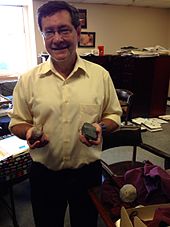
Rick Potts, head of Smithsonian Human Origins projection
The David H. Koch Hall of Human Origins opened on March 17, 2010, marking the museum's 100th ceremony. The hall is named for David H. Koch, who contributed $fifteen million to the $20.7 million exhibit.[52] [53]
The Hall is "dedicated to the discovery and agreement of human origins," and occupies 15,000 square feet (ane,400 yard2) of exhibit infinite. This exhibit includes 76 humans skulls, each of a different species, eons autonomously. Each of these species is a human, signified by the "Homo" genus name. One species that can be establish in this gallery is the Human heidelbergensis, which lived 200,000–700,000 years agone. In add-on, there is a female skull from Homo floresiensis, a human species that possibly only went extinct just 17,000 years agone.[54] The exhibit includes an interactive human family tree that follows six one thousand thousand years of evolution,[55] and a "Changing the Globe" gallery that focuses on issues surrounding climate change and humans' bear upon on the world. The Hall's core concept idea is "What Does It Mean To Be Human", and focuses on milestones of human development such as walking upright, bigger brains, and symbolic idea. Likewise covered is the Smithsonian'due south meaning research on the geological and climate changes which occurred in East Africa during pregnant periods of Human Evolution. The exhibit highlights an actual fossil Neanderthal and replicas created by famed paleoartist, John Gurche.[54] The showroom has been criticized for downplaying the significance of man-acquired global warming.[56] [57]
The showroom as well provides a complementary web site, which provides diaries and podcasts directly from related fields of research. The companion book, What Does Information technology Mean To Be Human, was written by Richard (Rick) Potts, the curator, and Christopher Sloan. The exhibit was designed by Reich + Petch.[58]
Dinosaurs/Hall of Paleobiology [edit]

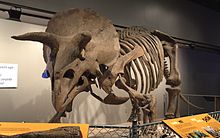
A FossiLab volunteer uses lab equipment to sift through collected sediments for bone particles at the Smithsonian National Museum of Natural History.
The Hall of Dinosaurs has fossilized skeletons and bandage models, including a Tyrannosaurus rex cast facing a Triceratops cast. This Triceratops exhibit shows the first authentic dinosaur skeleton in virtual motion, accomplished through the use of scanning and digital technology."[59] [60] The drove consists of 46 "consummate and of import specimens" of dinosaurs.[61]
In May 2012, billionaire David H. Koch donated $35 1000000 toward the cost of a $45 million upgrade to the 30-year-old, 25,000 square anxiety (two,300 one thousand2) dinosaur hall. The hall closed in the spring of 2014 and reopened in 2019.[62]
In June 2013, the Smithsonian obtained a 50-year lease on a T. male monarch fossil skeleton owned by the U.s. Army Corps of Engineers. It is the first T. rex skeleton to be displayed at the museum, which until now has but had the cast of a skull. The specimen, known as the "Wankel" or "Devil" male monarch,[63] was establish on Corps-owned land in the Charles G. Russell National Wild fauna Refuge in Montana in 1988. It has since been on display at the Museum of the Rockies in Bozeman, Montana (which helped excavate the fossil).[64] The "Wankel rex" (whose skeleton is 85 percent complete)[65] was to exist unveiled at the Museum of Natural History on National Fossil Twenty-four hours, October xvi, 2013, and was supposed to exist on display until the dinosaur hall exhibit closes for renovation in the leap of 2014. The 35-foot (11 m) long skeleton will be the centerpiece of the dinosaur hall when it re-opens in 2019.[64] The Museum of the Rockies (which did not own the skeleton but was the repository for it) has about a dozen T. rex specimens, including one which is eighty percent complete. Only almost vi museums in the U.s.a. have a T. rex skeleton. The Museum of the Rockies is a Smithsonian affiliate museum, and had long promised to detect a T. rex for the Smithsonian to brandish.[65]
Due to the 2013 federal government shutdown, the fossil did not arrive in Washington, D.C. Smithsonian officials said information technology remained in storage in Montana, and would non go far at the Smithsonian until late leap 2014. Packed up in 16 crates, the T. rex, named "Nation'due south T. king" by the Smithsonian, traveled from the Museum of the Rockies and arrived at the National Museum of Natural History on April 15, 2014.[66] The T. king was displayed in the Rex Room, while specialists performed a conservation assessment and the Smithsonian Digitization Program scanned each bone, to create a 3-D model for research.[67] The Nation'south T. rex is the centerpiece of the new fossil hall, which opened in 2019.[68]
Hall of Mammals [edit]
The Behring Hall of Mammals was designed by Reich + Petch. The mammal specimens are presented as works of modern fine art within minimal environmentals. Visitors detect mammal's evolutionary adaptions to hugely diverse contexts, and ultimately detect that they too are mammals.[ citation needed ]
The museum has the largest collection of vertebrate specimens in the earth, near twice the size of the next largest mammal collections, including historically important collections from the nineteenth and early twentieth centuries.[69] Its collection was initiated by C. Hart Merriam and the U.S. Section of Agriculture (later the Department of the Interior), which expanded information technology in the 1890s-1930s.[70]
Insect Zoo [edit]
The O. Orkin Insect Zoo features live insects and exhibits about insects and entomologists. Different habitats accept been created to show the type of insects that live in different environments and how they have adapted to a freshwater pond, house, mangrove swamp, desert, and pelting woods. The zoo is sponsored past Orkin, a pest control company.
Ocean Hall [edit]

The Sant Ocean Hall opened on September 27, 2008, and is the largest renovation of the museum since it opened in 1910. The hall includes 674 marine specimens and models drawn from the over 80 million specimens in the museum's total drove, the largest in the globe. The hall is named for the Roger Sant family, who donated $xv million to endow the new hall and other related programs.
The collection includes: a North Atlantic right whale, a giant Lion'due south mane jellyfish model, a one,500-Us-gallon (5,700 l) aquarium, one female giant squid displayed in the center of the hall and a male displayed off to the side, an adult coelenterate, and a Basilosaurus.[71]
The museum besides provides the Smithsonian Ocean Portal, a complementary web site that provides regularly updated, original content from the museum's research, collections, and Sant Bounding main Hall besides as content provided by more than 20 collaborating organizations, including Archive, Census of Marine Life, Consortium for Body of water Leadership, Encyclopedia of Life, INDUCT, Monterrey Bay Aquarium, Monterrey Bay Aquarium Inquiry Constitute, National Geographic, NOAA, New England Aquarium, Body of water Conservancy, Oceania, Pew Charitable Trusts, Body of water Web, Salve Our Seas, Scrips Institution of Oceanography, Woods Hole Oceanographic Institution, World Heritage Marine Programmer.
African Voices [edit]
This exhibit and associated website "examines the multifariousness, dynamism, and global influence of Africa's peoples and cultures over time in the realms of family unit, work, community, and the natural environment."[72]
Butterflies + Plants: Partners In Evolution [edit]
Featuring a live butterfly pavilion allows "visitors to detect the many means in which collywobbles and other animals have evolved, adjusted, and diversified together with their plant partners over tens of millions of years."[72] The exhibit was designed past Reich + Petch.
Western Cultures Hall [edit]
"This hall explores some examples from various cultures in the western world including northern Republic of iraq, ancient Egypt, Hellenic republic and Rome and the recent discovery of the Iceman, a Copper Age mummy found in an Italian glacier."[72] This exhibit closed September 26, 2010.
Korea Gallery [edit]
The Korea Gallery is a special showcase to celebrate Korean traditions and examine its unique influence and complex role in the globe today.
The exhibit expresses the continuity of the past past highlighting indelible features of Korean culture that have influence and resonance today.[ citation needed ] The exhibit uses the Smithsonian ceramics drove as well equally a rich selection of photographs, ritual objects and traditional Korean carpentry to communicate and connect to both the local Korean community and an international audition. Traditional art forms, such as ceramics and calligraphy, along with mythological figures, language, large feature photographs and illustrations speak to a range of shared historical memories that connect Koreans at home and abroad.
Personal stories of modern Koreans, equally told in their ain voices, provide a context to discuss some of the many issues that face the divided country today. Korea'southward incredible transformation from 'The Hermit Kingdom' to a globe power is traced through its impact on the arts, the economy and popular culture.[ citation needed ] The exhibit was designed by Reich + Petch. This showroom airtight in 2017.
Teleology: Hall of Basic [edit]
This exhibit displays a "diverseness of vertebrate skeletons grouped by their evolutionary relationships."[72]
Q?rius [edit]
Opened since 2013, this exhibit is the museum'due south interactive and educational area. Using microscopes and affect screens, the surface area hosts various interactive activities and puzzles visitors tin experience and contains a "drove zone" that houses over 6000 different specimens and artifacts visitors are able personally handle. The surface area also hosts various events such as allowing visitors to meet and discuss with Smithsonian scientists and hosting schoolhouse groups.[73]
Other [edit]
The Discovery Room, a family- and student-friendly hands-on activity room on the first flooring.[74]
In the lower level, there is a bird showroom, Urban Bird Habitat Garden, with all the migratory and native birds to Washington, D.C.[75]
The Global Volcanism Program is housed in the department of Mineral Sciences.
The museum frequently hosts sleepovers through the Smithsonian Associates for children ages 8–12.[76]
Gallery [edit]
-

Rotunda during the day
-

Rotunda at nighttime
-

Former Hall of Dinosaurs
-
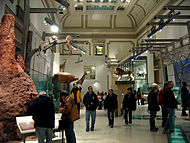
Hall of Mammals
-

Hall of Mammals
-

Hall of Bounding main Life
-

In pop culture [edit]
- The exteriors of the Museum were used equally a model for the "Leyendecker Museum" in the Sierra On-Line 1992 run a risk game The Dagger of Amon Ra.
- In the 2008 video game Fallout 3, a derelict exhibit at the museum serves as the archway to Underworld, a culture established past ghouls.
- In the 2008 picture Get Smart, the fictional spy organization CONTROL is located underneath the National Museum of Natural History.
- The giant squid from the National Museum of Natural History inspired the octopus that comes to life in 20th Century Fox's 2009 flick Night at the Museum: Boxing of the Smithsonian.[77]
- A version of the museum is featured equally a partially-explorable location and i of the few quarantined areas in the 2019 tertiary-person shooter The Division 2.
- A cartoon of the museum was featured in an episode of the blithe comedy Inside Job in 2021.
Run across also [edit]
- John Varden
- Listing of most-visited museums in the United States
References [edit]
- ^ TEA-AECOM Museum Index 2020, published September 2021
- ^ "The Earth'south most pop museums", CNN.com, 22 June 2017.
- ^ a b c "Enquiry & Collections". National Museum of Natural History. Archived from the original on fifteen Apr 2012. Retrieved 12 April 2012.
- ^ "Collections at the National Museum of Natural History". National Museum of Natural History. Archived from the original on 6 February 2019. Retrieved 19 February 2020.
- ^ Johnson, Kirk (2 March 2019). "Smithsonian Museum and Zoo records the natural world as it collides with human civilisation" (Interview). Interviewed by Robyn Williams. Australian Broadcasting Corporation. Archived from the original on 26 February 2020. Retrieved 26 Feb 2020.
- ^ D'Angelis, p. 35.
- ^ Evelyn, Dickson, and Ackerman, p. 107.
- ^ "Plans for Museum Building." Washington Mail. July 6, 1902.
- ^ a b "New Building for Museum." Washington Post. Jan 30, 1903.
- ^ "Site of New National Museum." Washington Postal service. March 7, 1903.
- ^ a b "New Museum Plans." Washington Postal service. April 13, 1903.
- ^ "Museum Building Blueprint." Washington Post. May 24, 1903.
- ^ "This Day in Smithsonian History - March". Siarchives.si.edu. Archived from the original on 2010-06-08. Retrieved 2010-04-xviii .
- ^ "Museum History". National Museum of Natural History. 2008. Archived from the original on 2009-07-26. Retrieved 2009-11-fifteen .
- ^ Bache, Rene. "America's $three,500,000 National Museum, Just Completed, Most Remarkable Structure of Its Kind in the World." Washington Mail service. March half-dozen, 1910.
- ^ a b Trescott, Jacqueline. "Smithsonian Taps Biologist For Natural History Museum." Washington Postal service. Jan thirty, 2003.
- ^ "Smithsonian Selects Friday for Natural History Post." Orlando Lookout man. March 21, 1996.
- ^ a b Olson, Elizabeth. "A Biologist Will Lead Smithsonian Museum." New York Times. January 30, 2003.
- ^ "Washington: New Museum Managing director." New York Times. July 26, 2001.
- ^ Wiltz, Teresa. "Smithsonian Losing a Sixth Key Director." Washington Post. Apr 4, 2002.
- ^ "Acting Chief Named At Natural History." Washington Post. June 6, 2002.
- ^ a b "Biologist Named to Head Smithsonian Natural History Museum." Associated Press. January 29, 2003.
- ^ Epstein, Edward. "East Bay Programmer Pumps Millions Into Smithsonian Project." San Francisco Relate. Nov fifteen, 2003.
- ^ Trescott, Jacqueline. "Museum to Go $lx One thousand thousand Exhibit." Washington Mail service. September sixteen, 2004.
- ^ "Tiffany Makes $1.1 One thousand thousand Gift to Smithsonian Museum." Associated Press. June vii, 2006.
- ^ Zongker, Brett. "Smithsonian's Top Official Resigns." Associated Press. March 26, 2007.
- ^ Pogrebin, Robin. "Smithsonian Scrambles to Regain Its Footing." New York Times. April iv, 2007.
- ^ "Acting Director Named at Smithsonian's Natural History Museum." Associated Press. March 30, 2007.
- ^ a b c d eastward f g h Grimaldi, James Five. and Trescott, Jacqueline. "Scientists Fault Climate Exhibit Changes." Washington Post. November 16, 2007.
- ^ Zongker, Brett. "Smithsonian Toned Down Showroom on Chill." Associated Press. May 21, 2007.
- ^ Pogrebin, Robin. "Gift to Smithsonian Is Rescinded." New York Times. Nov 17, 2007.
- ^ "Head of Smithsonian's Natural History Museum Returning to OU." Associated Press. January 23, 2008.
- ^ "GIT President to Head Smithsonian." United Press International. March 15, 2008.
- ^ "Couple Gives $15M for Smithsonian Bounding main Hall." Associated Press. June 26, 2008.
- ^ Schmid, Randolph Eastward. "Hope Diamond to Get New Setting for Anniversary." Associated Printing. August nineteen, 2009.
- ^ Zongker, Brett. "Smithsonian Opens $21M Human Development Hall." Associated Press. March 17, 2010; Brotherton, Elizabeth. "Natural History Details Origin of Our Species." Roll Call. March 22, 2010.
- ^ Zongker, Brett. "Caput of Smithsonian Natural History Museum Resigns." Associated Printing. January 23, 2012.
- ^ Trescott, Jacqueline. "Natural History Museum Gets $35 Million Gift." Washington Mail. May 4, 2012; "Koch Gives Smithsonian $35M for New Dinosaur Hall." Associated Press. May 3, 2012.
- ^ Trescott, Jaqcqueline. "Sants Give $10 Meg to Natural History Museum." Washington Post. June 27, 2012.
- ^ Parker, Lonnae O'Neal. "Smithsonian Names New Managing director of Natural History Museum." Washington Post. July 26, 2012; Zongker, Brett. "Smithsonian Picks Paleontologist to Pb DC Museum." Associated Press. July 26, 2012.
- ^ Kamen, Al. "Meet the Smithsonian's Fossil Guy." Washington Mail. August 20, 2013. Archived July nineteen, 2017, at the Wayback Machine Accessed 2013-08-20.
- ^ "Collections at the National Museum of Natural History | Smithsonian National Museum of Natural History". naturalhistory.si.edu . Retrieved 2022-04-13 .
- ^ "NMNH Fact Sheet". Smithsonian Institution. Archived from the original on 19 October 2019. Retrieved 26 Feb 2020.
- ^ a b c d "About the Museum". National Museum of Natural History. Archived from the original on fifteen August 2012. Retrieved 31 July 2012.
- ^ "Vertebrate Zoology: Segmentation of Amphibians & Reptiles". National Museum of Natural History. 2008. Archived from the original on 2008-10-21. Retrieved 2008-09-17 .
- ^ "Division of Amphibians & Reptiles". National Museum of Natural History. 2020. Archived from the original on 16 December 2019. Retrieved 26 Feb 2020.
- ^ "Loan Program". National Museum of Natural History. Archived from the original on 6 February 2019. Retrieved 26 February 2020.
- ^ "Museum Support Middle Library". Smithsonian Libraries. Archived from the original on 2 July 2012. Retrieved ii August 2012.
- ^ Juliet Eilperin. Trump has long vowed to slash government Archived 2018-03-11 at the Wayback Car. Washington Mail. 26 February 2018
- ^ a b Hevesi, Dennis (2008-04-06). "George Switzer, 92, Dies; Started a Gem Treasury". New York Times. Archived from the original on 2013-12-20. Retrieved 2008-04-09 .
- ^ "Department of Mineral Sciences Collections Overview". Smithsonian Institution. Archived from the original on iii August 2019. Retrieved 26 February 2020.
- ^ Klein, Julia M. (May 11, 2010). "Our Species Rediscovers Its Cousin". Wall Street Journal.
- ^ "Smithsonian Opens Human Evolution Hall". CBS News. March 17, 2010. Archived from the original on 22 Oct 2014. Retrieved 17 October 2014.
- ^ a b Rothstein, Edward (March xviii, 2010). "Searching the Bones of Our Shared Past". Archived from the original on 27 October 2014. Retrieved 17 Oct 2014.
- ^ O'Sullivan, Michael (March 19, 2010). "Smithsonian's Natural History Museum opens its Hall of Human Origins". The Washington Post. Archived from the original on 25 October 2014. Retrieved 17 Oct 2014.
- ^ "Polluter-Funded Evolution & Climate Exhibit at the Smithsonian". National Wildlife Federation. 2010-09-10. Archived from the original on 2014-05-06.
- ^ Mayer, Jane (August thirty, 2010). "Covert Operations: The billionaire brothers who are waging a war confronting Obama". The New Yorker. Archived from the original on October vii, 2012. Retrieved March xx, 2015.
- ^ "New Exhibition Hall Devoted to Human Origins Opens at National Museum of Natural History". National Museum of Natural History. March 2010. Retrieved 2010-03-16 . [ dead link ]
- ^ "New and Improved". National Geographic. December 1, 2000. Retrieved 2008-09-17 . [ dead link ]
- ^ "Dinosaur Hall". National Museum of Natural History. 2008. Archived from the original on 2008-09-13. Retrieved 2008-09-17 .
- ^ "Dinosaur Collections". National Museum of Natural History. 2008. Archived from the original on 2008-09-13. Retrieved 2008-09-17 .
- ^ Trescott, Jacqueline. "David Koch Donates $35 Million to National Museum of Natural History for Dinosaur Hall." Washington Post. May 3, 2012. Archived July 19, 2017, at the Wayback Machine Accessed 2012-05-28.
- ^ The specimen was establish in sediments known every bit the Hell Creek Formation, hence the name "Devil rex".
- ^ a b du Lac, J. Freedom "Tyrannosaurus rex Gets Long-Term Lease at Smithsonian's Natural History Museum." Washington Post. June 27, 2013. Archived July xx, 2017, at the Wayback Machine Accessed 2013-06-28.
- ^ a b Schontzler, Gail. "Montana T. rex Heading to Smithsonian." Bozeman Daily Chronicle. June 28, 2013. Archived July 7, 2013, at the Wayback Car Accessed 2013-06-28.
- ^ "The Nation's T. Rex Invades the Smithsonian". nationalgeographic.com. 17 April 2014. Archived from the original on 1 July 2017. Retrieved 2 May 2018.
- ^ "How to 3-D impress a dinosaur". PBS NewsHour. 2014-06-25. Archived from the original on xv July 2017. Retrieved 2 May 2018.
- ^ Lac, J. Liberty du (15 April 2014). "T. rex fossils get in at Smithsonian's National Museum of Natural History". Archived from the original on nineteen July 2017. Retrieved 2 May 2018 – via www.washingtonpost.com.
- ^ "Section of Vertebrate Zoology". National Museum of Natural History. 2008. Archived from the original on 2008-09-17. Retrieved 2008-09-17 .
- ^ "Vertebrate Zoology: Division of Mammals". National Museum of Natural History. 2008. Archived from the original on 2008-08-02. Retrieved 2008-09-17 .
- ^ "The New Sant Ocean Hall Opens Sept 27. at the Smithsonian's National Museum of Natural History" (PDF). National Museum of Natural History. September 24, 2008. Archived from the original (PDF) on April 9, 2009. Retrieved 2009-07-28 .
- ^ a b c d "Current Exhibitions". National Museum of Natural History. Archived from the original on 2009-07-27.
- ^ "Q?rius, The Coralyn West. Whitney Science Education Center". si.edu. 9 September 2015. Archived from the original on 12 September 2017. Retrieved 2 May 2018.
- ^ "National Museum of Natural History - Smithsonian Institution". Washington Post. 2008. Retrieved 2008-09-17 .
- ^ "Urban Bird Habitat Garden". Exhibitions. Smithsonian Institution. Archived from the original on 24 October 2012. Retrieved 24 October 2012.
- ^ "Smithsonian Sleepovers". Smithsonian Establishment. Archived from the original on 16 July 2016. Retrieved 10 July 2016.
- ^ ""Night at the Museum: Boxing of the Smithsonian" Treasure Map". Smithsonian Institution. Archived from the original on 2009-05-17.
Bibliography [edit]
- D'Angelis, Gina. It Happened in Washington, D.C. Guilford, Conn.: TwoDot, 2004.
- Evelyn, Dougas E.; Dickson, Paul; and Ackerman, S.J. On This Spot: Pinpointing the Past in Washington, D.C. Sterling, Va.: Capital Books, 2008.
- Redman, Samuel J. Bone Rooms: From Scientific Racism to Human Prehistory in Museums. Cambridge: Harvard University Press. 2016.
External links [edit]
-
 Geographic data related to National Museum of Natural History at OpenStreetMap
 - National Museum of Natural History official website
- A Cursory History of the Museum - from the NMNH website
- National Museum of Natural History - National Gem and Mineral Collection
- Research collections of the National Museum of Natural History
- Finding Aid to the Records of the Department of Anthropology, United States National Museum-National Museum of Natural History, Manuscript and Pamphlet File, National Anthropological Archives, Smithsonian Institution
- Smithsonian National Museum of Natural History at Google Cultural Institute
Source: https://en.wikipedia.org/wiki/National_Museum_of_Natural_History
Posted by: kraemergrance.blogspot.com
0 Response to "What Animals Are At The Natural History Museum"
Post a Comment