

What Animal Is Manfred In Ice Age
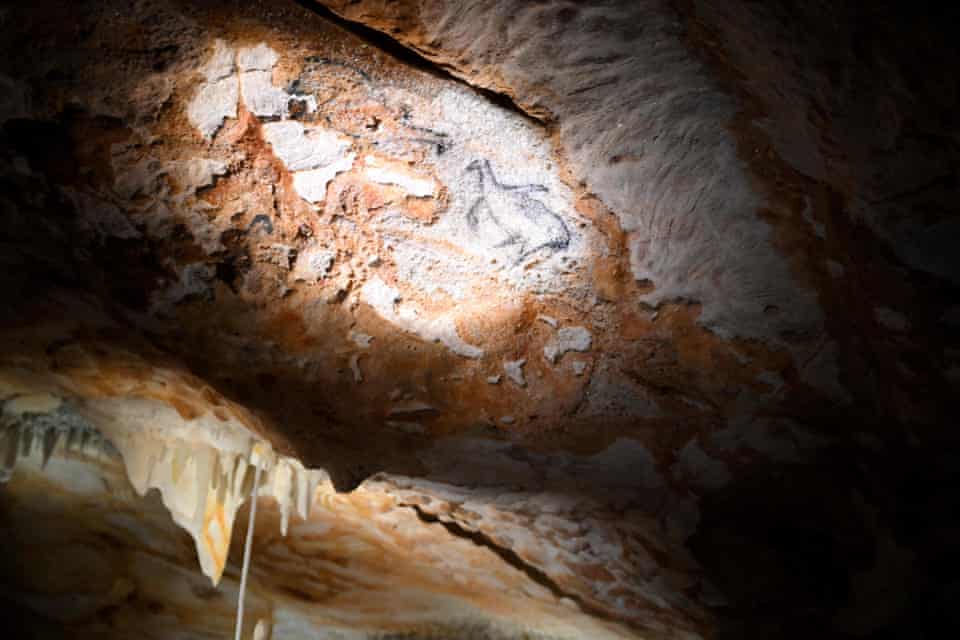
I t was in 1985 that the diver Henri Cosquer discovered, along the coast from Marseille, what has been chosen an "underwater Lascaux" subsequently the famous cave network in the Dordogne. Afterward several failed attempts, he managed to follow a narrow tunnel, 120ft below the surface of the body of water, for almost 400ft and emerged in a stunning decorated bedroom. Subsequent visits revealed many images of the horses, ibexes and deer common in prehistoric cave fine art, but besides unprecedented pictures of seals and what wait very much similar penguins, including 1 which seems to bear witness two males competing for a watching female. This initially raised questions virtually authenticity, though carbon dating of the charcoal confirmed that the drawings were prehistoric. The birds were later identified not as penguins but keen auks (known in French as grands pingouins), an extinct species that looks similar but is not in fact closely related.
The cavern came to wider public attending when three divers drowned in that location in 1991. It was classified as a celebrated monument the following year and the French land has conducted always more precise and detailed surveys using laser scanners and loftier-definition photography. Portable devices can now likewise carry out chemical assay, for example of pigments, on the spot. Merely the Cosquer cave is the just known busy cave with an entrance under the ocean, and until now information technology has only been accessible to very experienced defined. Global warming means that information technology is eventually probable to be submerged and that its amazing rock art will only be preserved virtually. It is particularly to be welcomed, therefore, that a compellingly authentic replica has now opened to the public at a prime site in Marseille, where it is hoped it will concenter about 500,000 visitors a year.
Geologist and prehistorian Jacques Collina-Girard, who lectures at Aix-Marseille University, said a number of things fabricated the cavern unique. It was the first grotto decorated with prehistoric paintings institute in Provence, and "a sanctuary of its blazon demonstrated that a significant population lived in the area". Fifty-fifty though rising sea levels hateful that the cave was in one case about iv miles inland, information technology was still "nearer the bounding main than other major sites" and the animals represented inside it indicated that "people of that catamenia maintained contact with the sea and the coastal areas". It has therefore helped to dispel the common image of prehistoric people every bit essentially inland hunters.
The Cosquer cavern takes us dorsum to a time when France was equally cold as today'south Republic of iceland. It appears to take been visited, but not lived in, over an unparalleled menstruum of 14,000 years – from 33,000 to 19,000 years agone. And it contains more than 500 separate images – some engraved with flint tools, some painted with fingers or made with charcoal now identified as coming from Scots pine. Experts speculate about the similarities and differences in how item animals are represented in cave art beyond wide geographical areas, and what they tell u.s.a. about cultural groupings. They try to interpret enigmatic images such every bit 1 which seems to represent a seal-headed man pierced past a spear or harpoon. And what nigh the handprints, constitute in Cosquer and a few other places, where parts of some fingers are missing? Had these been deliberately cut off or lost to frostbite? Or were the prints only made by people who had folded over some of their fingers, to correspond a silent form of signalling, possibly used in hunting, or to convey some spiritual meaning, rather like the sign of the cross?
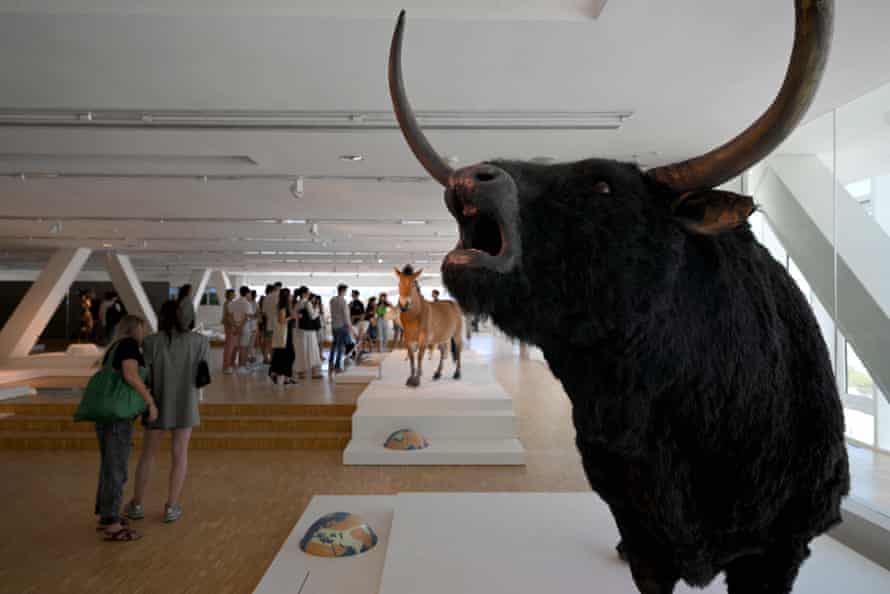
The port in Marseille, where the new replica is sited, has always had a somewhat colourful reputation, with its crooks, chancers and poissonières (fishwives) famous for greeting customers with fruity sales pitches. A neglected area was transformed when the city was European uppercase of culture in 2013, with the cosmos of the MuCEM (Musée des civilisations de l'Europe et de la Méditerranée), the Musée Regards de Provence, devoted to the fine art of the region, and a striking building called La Villa Méditerranée. The last of these is within an artificial sea bowl and notable for a huge overhanging cantilever, giving it a shape like an inverted L – locals have nicknamed it the Stapler and the Cap. Owned past the Provence-Alpes-Côte d'Azur region, information technology had no obvious part and so forms a perfect domicile for the replica at Cosquer Méditerranée.
The contract was awarded to Kléber Rossillon, a company already responsible for a like project at the Chauvet cave in the Ardèche, virtually 100 miles to the north-west. So how was information technology possible for the architects, designers and technicians to recreate every particular of an surround they lacked the diving skills to go and visit for themselves?
"The national institutions created the numerical data nigh the cavern and gave u.s.a. all the documents, all the 3D data," says Cosquer Méditerranée's managing director, Frédéric Prades. "We committed ourselves to setting up a scientific committee fabricated upward of eminent historians, geologists, etc [led by Collina-Girard]. They followed the whole working process. It's a guarantee that the effect is scientifically true-blue to the original. Even when we created the connecting tunnels, we consulted the geologists and they said: if we had had to dig a tunnel in the rock [on the original site], it would have looked like that, with that kind of rock."
A visitor called Perspective(s) candy the digital data, 344 light amplification by stimulated emission of radiation scans and 360-degree high-definition images to create a 3D model of the cave. This meant that the engineers and designers could put on virtual reality helmets and feel they were wandering about in it.
A digital milling auto used the 3D modelling to sculpt polystyrene blocks equally moulds for the resin panels on to which photographs were projected. Expert painters then painstakingly recreated the original images past hand. Other specialists were employed to make reproductions of the stalactites and stalagmites, and to reproduce the exact matt, transparent and sparkling surfaces constitute in the cave.
"The physical replica itself is non a tool for scientists," Prades stresses. "Simply the virtual reality piece of work which allowed usa to create our replica grotto will also be used by scientists – who will be able to move around in the cave without having to go there."
The other key challenge was plumbing fixtures the original cavern into the slightly smaller space available cloak-and-dagger at the Villa Méditerranée and "winding" information technology around the essential metal back up beams. In some cases, ascent body of water levels mean that there is now very little infinite in the existent cave between the floor level and a ceiling on which there is a hit paradigm or design. And it is entered in the middle of a sequence of spaces which co-operative out in both directions but finish in culs-de-sac.
Information technology was therefore decided to include stylised admission tunnels and to twist the real space to adapt an exploratory vehicle which takes visitors through a serial of vi rooms on a circuit shaped like a squashed figure of eight, without having to retrace its route. Nonetheless, the replica feels utterly accurate as yous are taken on a 35-minute journey through every part of the cavern a visiting diver could see without having to crawl. This includes all the paintings and black drawings and 95% of the engravings. The visit also features several films about how the replica was created, though Prades reports that they had "a long give-and-take most whether we should have such films, because information technology is important to proceed the magic and forget you lot are not in a cave".
-
More data can be found here
Source: https://www.theguardian.com/science/2022/jul/02/ice-age-provence-cosquer-cave-archaeology
Posted by: kraemergrance.blogspot.com
0 Response to "What Animal Is Manfred In Ice Age"
Post a Comment