

Is There An Uncanny Valley For Animals
Similar humans, monkeys fall into the 'uncanny valley'
Oct. 13, 2009, xi a.m.
Princeton University researchers have come up with a new twist on the mysterious visual phenomenon experienced by humans known as the "uncanny valley." The scientists accept found that monkeys sense it too.
The uncanny valley, a phrase coined by a Japanese researcher nearly 3 decades ago, describes that disquieting feeling that occurs when viewers look at representations designed to be as man-similar as possible -- whether computer animations or androids -- but somehow fall short.
Movie-goers may not be familiar with the term, but they empathize that it is far easier to beloved the out-of-proportion drawing figures in the "The Incredibles," for case, than it is to embrace the more realistic-looking characters in "The Polar Express." Viewers, to many a Hollywood director'due south consternation, are emotionally unsettled by images of bogus humans that expect both realistic and unrealistic at the same time.
In an endeavour to add to the emerging scientific literature on the subject and respond deeper questions about the evolutionary basis of advice, Princeton University researchers have found that macaque monkeys also fall into the uncanny valley, exhibiting this reaction when looking at computer-generated images of monkeys that are close simply less than perfect representations.
"Increased realism does non necessarily lead to increased acceptance," said Asif Ghazanfar, an banana professor of psychology and the Princeton Neuroscience Found, who led the inquiry. It is the get-go such finding in any animal other than human. The paper, co-written by Shawn Steckenfinger, a enquiry specialist in the Princeton's Section of Psychology, appears in the October October. 12 edition of the Proceedings of the National Academy of Sciences.
The piece of work, according to its authors, is meaning because it indicates that there is a biological footing for the uncanny valley and supports theories that propose that the brain mechanisms underlying the uncanny valley are evolutionary adaptations. "These data demonstrate that the uncanny valley consequence is not unique to humans and that evolutionary hypotheses regarding its origins are tenable," said Ghazanfar.
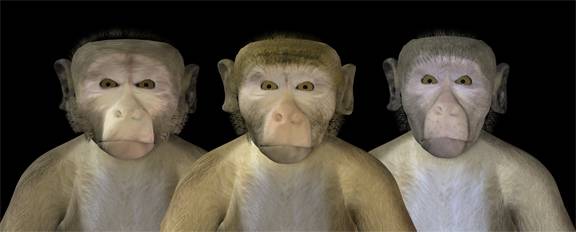
Realistic-looking robots and computer avatars oftentimes spur negative responses in humans. Princeton Academy scientists showed monkeys these computer-generated images of monkeys and saw a similar response. Monkeys, they found, too are unsettled by images that are realistic but constructed, a response known as the "uncanny valley" effect. (Photograph: Courtesy of Shawn Steckenfinger)
The uncanny valley hypothesis was introduced by the Japanese roboticist Masahiro Mori in 1970. The "valley" refers to a dip in a graph that charts a human's positive reaction in response to an prototype on 1 axis and a robot's man-likeness on some other. People like to study other human faces, and they besides can enjoy scrutinizing countenances that clearly are not human, such every bit a doll'due south or a cartoon figure's. But when an image falls in betwixt -- close to human just clearly non -- it causes a feeling of revulsion.
Experts praised the Princeton report.
"This study makes a significant contribution to existing noesis of the uncanny valley," said Karl MacDorman, an associate professor in the School of Informatics at Indiana University, who has led of import experiments in the fields of android scientific discipline and computational neuroscience. "The inquiry design is novel, the experiment is carried out with a high degree of rigor, and the results are compelling, important, newsworthy, and support the [hypothesis]."
He believes the results will be of broad involvement to scientists and non-scientists, including "ethologists, brute behaviorists, cognitive psychologists of human perception, evolutionary psychologists, primate social cognitive neuroscientists, humanoid roboticists and human grapheme animators."
In the experiments, the monkeys, which normally coo and smack their lips to engage each other, quickly avert their glances and are frightened when confronted past the close-to-existent images. When asked to peer at the less shut-to-existent faces and existent faces, however, they viewed them more often and for longer periods.
Despite the widespread acknowledgement of the uncanny valley as a valid phenomenon, in that location are no clear explanations for it, Ghazanfar said. One theory suggests that it is the outcome of a "cloy response" mechanism that allows humans to avoid disease. Another idea holds that the phenomenon is an indicator of humanity's highly evolved confront processing abilities. Some take suggested the corpse-like appearance of some images elicits an innate fear of death. Still others accept posited that the response illustrates what is perceived every bit a threat to homo identity.
Ghazanfar said the research is likely to indicate him in useful directions to farther explore these theories.
The inquiry was funded by the National Science Foundation.
Source: https://www.princeton.edu/news/2009/10/13/humans-monkeys-fall-uncanny-valley
Posted by: kraemergrance.blogspot.com
0 Response to "Is There An Uncanny Valley For Animals"
Post a Comment