

How To Tame Animals In No Man's Sky
 | The bailiwick of this article is from the Frontiers update. The information from this article is up-to-date as of fifteen Feb, 2022. |
The subject of this article is from the Frontiers update.
The information from this article is up-to-date every bit of fifteen February, 2022.
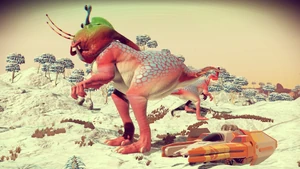
The Caesarus, largest documented creature species. (Extinct after Update 1.xxx.)
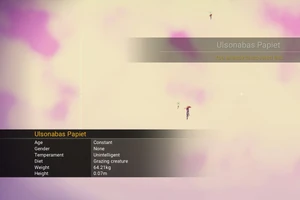
Ulsonabas Papiet, smallest documented fauna species. (Extinct afterward Update 1.30.)
Fauna includes all lifeforms capable of complimentary movement.
Contents
- i Summary
- ii Gender
- 3 Age
- 4 Diets
- four.1 Appreciable Behavior Touch on
- 4.2 Carnivore
- 5 Allurement
- 6 Height & Weight
- 6.1 Megafauna
- 7 Ecosystems
- 8 Activeness Periods: Nocturnal / Diurnal Behaviour
- 9 Temperament: Predatory / Defensive Behaviours
- 10 Temperament List
- 11 Divisions & Scientific Proper noun
- 12 Family unit
- 13 Genus
- fourteen Species & Family
- 14.ane Examples of Families and Common Traits
- 15 Species & Gender
- 16 Using Taxonomy
- 17 Divergent Species
- eighteen Planet Variety
Summary [ ]
In No Human being'due south Sky, Brute is the "umbrella category" which includes all lifeforms capable of moving around the environment on their own. Although the strictest definition could exist used to depict humanoid life (Gek, Korvax, Vy'groovy, and perhaps Travellers), "fauna" is not commonly used to describe humanoids.
Their nearby location can be identified on a scanner equally red dots (new species) and green pawprints (already scanned). About species besides vocalize (with roars, "yells," squeals, etc). Animate being tin be plant anywhere on a planet, including in the air, although some planets will have no fauna or areas (ground, underground, underwater or aerial) with no brute.
Upon landing on a new planet or checking a planet in the Discovery Menu (Pause Bill of fare), the density of fauna (or lack of animate being) on a planet can be checked. However, some animals described as "rare" will old overrun the actor's field of view while an "uncommon" animal will stay nowhere to exist found for an extended menstruation of time.
This category is commonly referred to every bit "animals," which may or may not be technically correct. In Earth biological science, "animal" refers to Animalia, which the bulk of No Man'due south Sky fauna practise indeed seem to resemble.
For records on the largest and smallest animal in the game, meet Fauna Hall of Fame.
Gender [ ]
Animate being in No Man's Heaven display 17 genders. Below is a list of all genders, and some possible meanings.
- Male-The masculine part of reproduction
- Female-The feminine function of reproduction
- Exotic- This species may non fit into any category plant on Earth genderwise.
- Unknown- The gender of this animal isn't known
- Indeterminate- It is impossible to say what genders be in this species
- Disproportionate - This may be the same as "hermaphroditic/monoecious" in Earth biology, organisms that are of the aforementioned sexual practice and can perform either or both sides of the mating act, like nearly snails.
- Non-uniform- This species may have multiple gender layouts beyond its unabridged species, much like several lizard species on Earth.
- Symmetric - Perhaps similar to asexual reproduction in World biological science.
- Rational
- Vectorized - Possibly relating to viruses, "a vector is an organism that does non cause disease itself but which spreads infection past conveying pathogens from i host to another." Replace "disease" with "pregnancy" and that may be how these organisms reproduce.
- Prime number
- Alpha- Similiar to silverback gorillas on Earth
- Radical
- Asymptotic - In geometry, the definition of asymptotic is "a line that approaches a curve merely never touches."
- Orthogonal - In geometry, this means "Of 2 objects, at right angles; perpendicular to each other."
- {undefined} - This displays equally "None" in the Discovery info.
- None
Terrestrial fauna species always have ii sexes. Aquatic fauna, flight beast, and butterflies e'er have ane sexual activity.
Age [ ]
Fauna age in 10 different ways. Below is a list of all historic period categories, and some possible meanings.
- Young: Infant, Young, Juvenile
- Mature: Adult, Mature, Elderly
- Other: Indeterminate (Age or crumbling design unknown), Abiding (Possibly ways they never age), Fluctuating (May be able to change their "age" based on their lifecycle, similar some jellyfish), Perpetual (Possibly "continually aging, never dying," effectively "immortal.")
Diets [ ]
Fauna can follow 9 dietary patterns, divided into three subgroups.
- Carnivore: Carnivore, Meat-Eater
- Herbivore: Vegetation, Absorbed Nutrients, Herbivore, Grazing Creature
- Omnivore: Scavenger, Insect-eater
- Pica: fauna with unusual diet ambition for Oxide elements, rocks or soil, etc.
Some of these categories may seem redundant - for example, "Carnivore" and "Meat-eater," or "Herbivore" and "Grazing Creature." However, at that place could be slight distinctions between each option which are thus far unclarified.
Observable Behavior Impact [ ]
Carnivorous and omnivorous species will be hostile to the role player, and sometimes other fauna.
Herbivores volition display grazing animations, perchance most noticeable with Rangifae (diplos) which lower their heads down to the ground with their long necks.
Carnivore [ ]
As a completely speculative example of possible distinctions, "Carnivore" may be the same equally "obligate carnivore" in Earth biology, animals that strictly eat meat and nothing else. While "Meat-eater" may exist the same equally "facultative carnivore," animals that eat mostly meat, but may occasionally eat plants every bit well (or in the case of NMS, other...elements). "Herbivore" could employ to any creature which eats plants, while "Grazing Creature" might specifically requires grazing behaviour.
Bait [ ]
Afterward scanning a species y'all are provided with information regarding "bait" which is used to tame creatures and take advantage of additional abilities.
- For types of baits currently identified, run into Cooking Products - Baits .
Some baits are merely for "pacification" of creatures and will make them friendly, similar to how y'all could feed them random amounts of isotopes in previous updates. This is now done with "nutrient pellets" as the everyman "tier" bait.
Higher tier baits may enable to ability to ride medium-big creatures. (This does include flight creatures of medium/large size) This aforementioned tier of bait allows the ability of harvesting/milking creatures.
Summit & Weight [ ]
The overall size of a species is determined past ii factors: its summit (or length) and its weight. As weight has no direct upshot on the game and seems to give unusual values at times (such every bit butterflies existence extremely dense), summit is usually considered the more of import characteristic.
Height is a measurement of how alpine a species is. Different genera have different size limits, primarily governed past their ecosystem (for case, there are no flying or aquatic creature above 4m, and certainly none in a higher place 8m). So far, no creatures above eight.43m have been confirmed. Eight (eight) meters tin can be considered the "soft limit," equally it seems no species volition grow much taller than that. The smallest known species is 0.07m. Note that with the Next release, the hundredths digit was dropped, providing a size range of viii.4m - 0.1m. Equally a result, the largest and smallest known species from Atlas Rises will never officially be exceeded.
Weight is a measurement of how heavy a species is. It'southward difficult to say how it'south determined, as the smallest species institute so far is every bit heavy as some species ~xiv times their size.
Megafauna [ ]
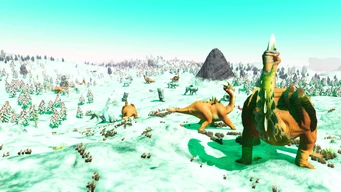
Megafauna.
At a certain size, a species will shake the ground with its footsteps (with the exception of hovering animal, similar winged Grunts or hovering Beetles). Such species are referred to as megafauna. Only certain beast tin can become megafauna - aquatic species, birds, and butterflies have a smaller "maximum size" than other types of fauna, and cannot abound to a true "megafauna size."
"Megafauna" is not a term used past the game, but the term is frequently used by the playerbase.
Ecosystems [ ]
Brute can be plant in four (technically five) ecosystems.
- Ground (Terrestrial & Hovering) - While y'all may think Hovering species would be in the Air ecosystem, they're really bound to the ground.
- Air (Flying) - Wraiths / flying serpent-like species, and flying winged species both big and small.
- Water (Aquatic) - Fish, predatory fish, jellyfish, segmented aquatic worms, aquatic mammals, shrimp-like species, etc.
- Caves (Subterranean) - Subterranean species are strictly blobs, arachnid/crustacean-like species, rodent-like species, and Prototerrae.
- Sentinels - This is the "simply technically an ecosystem." Sentinels are too the only entities allowed to freely cross between ecosystems, although actual fauna may cross betwixt them occasionally or by accident.
Action Periods: Nocturnal / Diurnal Behaviour [ ]
The day and night wheel affects the spawning of fauna. Unlike species will deport differently based on the time of day.
Nocturnal species are active strictly at night. Diurnal is the reverse, with these species but being found during the mean solar day. Many species are mostly nocturnal or more often than not diurnal, being more active during a certain fourth dimension but nonetheless present during the rest of the 24-hour interval. Creatures won't suddenly disappear if time cycles out of their period of action, but they will start/stop spawning new ones or increase/subtract their spawning frequency.
The following information is based on pre-Foundation datamining, simply it appears to still be accurate. So far, information technology appears that no updates have significantly changed how animate being spawning and behaviour piece of work, bated from increasing the maximum size of fauna.
- Some flight fauna will exist less agile or entirely inactive at night. There are no nocturnal or generally-nocturnal flight beast.
- Collywobbles on any planet are strictly diurnal.
- On well-nigh planets, predators are more active at night. They tin can be up to 8 times more agile, or even entirely nocturnal.
- The opposite is truthful on a smaller number planets - like "dinosaur planets." Sure predatory species will be four times more active during the twenty-four hour period, or strictly diurnal.
- A very minor number of passive species are strictly nocturnal; a larger number are strictly diurnal.
- Many passive species are more active during the day than during the night, but still agile at night. Some are unaffected by the time of solar day.
- Aquatic & subterranean brute are consistently active during all times of mean solar day and night.
Temperament: Predatory / Defensive Behaviours [ ]
Fauna can display both predatory and defensive behaviours.
Defensive behaviour may occur in the course of cocky-defense, or in the form of defending their immature. These are the only two known patterns of defensive behaviour. It appears fauna simply defend themselves confronting the player, not confronting predators.
Predatory behaviour can exist directed at the player or other fauna. There are 3 chief types of predators, and two other categories of brute behaviour.
- Predator - A standard predator, this volition assail any species classified every bit "prey," every bit well as the histrion.
- PlayerPredator - These predators will only attack the actor, not other beast. PlayerPredators are usually modest.
- Aquatic Predators / Sharks - These predators do not appear to attack other aquatic life, just volition assail the player.
- Prey - Prey species are usually non-hostile, but will defend themselves if attacked past the player. Prey species volition also defend their young, attacking the player if the player harms a young member of the species.
- Passive - Passive species are non-hostile species that will but flee when attacked; they volition not defend themselves under any circumstances.
Temperament List [ ]
Fauna also display Behaviour ("Temperament" prior to Side by side), listed in the Discovery Carte. There are 37 Behaviours divided into 5 subcategories. At this time, it'due south unclear if specific Behaviours inside a category take any effect on the behaviour of the fauna, or if all subcategories deport essentially the same.
"Generic" behaviours most likely apply to brute which brandish neither predatory nor defensive behaviour, such equally Ictaloris (fish) or Oxyacta (wraiths).
- Generic: Unintelligent, Migratory, Hibernator, Distinctive, Active, Erratic, Unpredictable, Assuming, Sedate
- Passive: Ambulatory, Amenable, At-home, Docile, Far-sighted, Passive, Submissive, Unconcerned, Wise
- Prey: Anxious, Cautious, Defensive, Fearful, Prey, Shy, Skittish, Timid
- Player Predator: Aggressive, Cruel, Dangerous, Hostile, Reckless, Vicious, Tearing,
- Predator: Hunting, Predator, Stalking, Unpredictable, Volatile
Equally Predators and Actor Predators have distinct temperaments, this listing tin can be used to determined whether or non a specific species volition attack other fauna or only the role player.
Divisions & Scientific Name [ ]
The broad category of fauna is further divided into three smaller categories based on Earth taxonomy. From most to to the lowest degree broad, these categories are Family, Genus,, and Species. The unabridged game has a full of 23 genera, while an individual family or species never appears on more than one planet.
Using the information below the player can more accurately name their planet'due south animals.
Family [ ]
(Annotation: In World biology, "Family" is a more wide category than "Genus.")
Families in No Man's Sky are much more than wide than they are in Globe biology, but they do share some characteristics. For example, on the planet Galactic Hub Summer Embassy, all Oxyacta species belong to the Idiumptu family, and ii aquatic species belong to the Kaspers family.
Unlike "Genus" and "Species," "Family" is not an bodily term used past the game code, but yet a useful term to describe the identical name parts between some species.
The family of a species can exist identified by the 2nd half of its scientific proper noun. For case, the Rigatori Niplatea species would vest to the Niplatea family.
Genus [ ]
Genus (pl. genera) is a characteristic of animal in No Man's Sky. Unlike the procedurally-generated Family characteristic, the game'south code references the Genus feature in determining where a species spawns. For example, the game will always spawn one butterfly species (genus Rhopalocera) and two predatory T-Rex species (genus Tyranocae) on "prehistoric planets." A genus is as well restricted to i (or in some cases two) ecosystems, ie, "Aquatic" or "Subterranean."
Species & Family [ ]
These groups appear to be isolated to ane planet - a species or family will never appear on two dissimilar planets. The proper name for each creature contains two procedurally-generated parts: a unique Species name (the first half) and a Family name (the 2nd half).
Families in No Man's Heaven are much more wide than they are in Earth biology, but they do share some characteristics. For case, one family unit may all be h2o dwellers, and others seem to all be four-legged terrestrial creatures. Unlike "Genus" and "Species," "Family unit" is not an actual term used past the game lawmaking, but nonetheless a useful term to describe the identical name parts between some species.
Examples of Families and Mutual Traits [ ]
- Bahalbus - Passive, quadrupedal terrestrial species.
- Ouisque - Beaked, flying bird-like species.
- Sitalie - Fish-like species with stripes / spots.
- Ubsans - Passive, quadrupedal terrestrial species.
Species & Gender [ ]
Besides gender, species is the near specific category of beast. Each species has one or two genders models: flight fauna e'er have one gender model while almost terrestrial creature have two gender models. Aquatic brute always have one gender model, with the exception of the Bosaquatica genus, which have two gender models. All species volition have two gender scans possible (ofttimes seen after save/reloading), with different gender names and potentially sizes. This is true fifty-fifty of those species which can merely nowadays i gender model associated with both gender scans.
Using Taxonomy [ ]
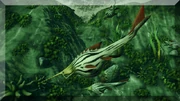
Acocuppl Hobell.
Using the information on family, genus, and species above, one tin can classify the Rigatori Nipatea as Niplatea (family), Rangifae (genus), and finally rigatori (species). The specific species, when being talked about, would then be simply referred to as "R. rigatori." This is called the scientific name, or the binomial nomenclature.
To assist further explain this process, here are a few more than examples of classifying a species.
- Evectagu Saviso: Saviso (family), Tetraceris (genus), evectagu (species). T. evectagu.
- Acocuppl Hobell: Hobell (family), Icaloris (genus), acocuppl (species). I. acocuppl.
- Befecus Nidustares: Nidustares (family), Ungulatis (genus), befecus (species). U. befecus.
Divergent Species [ ]
Divergent Species are a type of species in No Human being's Sky which, when scanned, do not count towards the Full Number of Species Discovered on the planet. These creatures are believed to be a glitch of the original scanned brute, creating a unlike version of the original species. They volition have the same statistics and advent as the species it originated from, but differing in preferred bait and species name, although opposing genders displayed in the Discoveries tab may give the illusion of 1 having a different height, weight, or advent. In rare circumstances, 1 may have a slightly dissimilar coloration or caput ornamentation. Information technology is currently unknown what triggers ane to announced, although exploring in multiplayer groups seems to increase their frequency.
Planet Diversity [ ]
The number of species found on a given planet will vary, with the boilerplate beingness 7-eight different types. Based on current records, the maximum species for any planet (based on ecosystem) are eight basis, 3 hush-hush, v underwater, and 5 flying.
Planets with 17 or more than species are rare, as they have reached at least 80% of the maximum. The following is a Top-10 listing.
| Species | Galaxy | Region | System | Planet | Glyphs | Coordinates | Discovered By | Release |
|---|---|---|---|---|---|---|---|---|
| xix | Euclid | Nugsdor Offshoot | Villus | Yoroz 54/K2 | 5102F9557C31 | 0430:0078:0D56:0102 | Galactic Hub Project | Frontiers |
| xix | Euclid | Yihelli Quadrant | AGT Rasho | Lilon XV | 2038F3545C3E | 043D:0072:0D44:0038 | Alliance of Galactic Travellers | Frontiers |
| 18 | Euclid | Navaneits | Asumido-Pitky | Riter | 03D8:007D:0D4B:0012 | Alliance of Galactic Travellers | Desolation* | |
| 17 | Itlhotagra | Mukuja Quadrant | (KTG) Flokumen Half-dozen | New Cebrast | 41D5FBCB59E8 | 01E7:007A:04B4:01D5 | Kosforr Travelers Club | Frontiers |
| 17 | Euclid | Nugsdor Adjunct | HUB5-220 Iscill | Dyl's Dystopia 7 | 4220F9557C31 | 0430:0078:0D56:0220 | Galactic Hub Project | Frontiers |
| 17 | Euclid | Nugsdor Offshoot | HUB5-1DC Whitchiss XIX | Egawa 42/U4 | 41DCF9557C31 | 0430:0078:0D56:01DC | Galactic Hub Project | Frontiers |
| 17 | Euclid | Nugsdor Adjunct | HUB5-120 Obostu | Totsdal Sigma | 3120F9557C31 | 0430:0078:0D56:0120 | Galactic Hub Project | Frontiers |
| 17 | Euclid | Nugsdor Adjunct | HUB-6A Nugtreath | Ought XVIII | 506AF9557C31 | 0430:0078:0D56:006A | Galactic Hub Project | Frontiers |
| 17 | Odyalutai | Wempdo Purlieus | AGT Xuding-Vistr | AGT Evizep K36 | 07F9:0085:07FD:0089 | Brotherhood of Galactic Travellers | NextGen | |
| 17 | Eissentam | Odyaks Shallows | Uderacle | Amta Sigma | 0807:0080:0800:0095 | InExCor | Origins |
Note: Species on planets prior to Origins are now extinct.
Source: https://nomanssky.fandom.com/wiki/Fauna
Posted by: kraemergrance.blogspot.com
0 Response to "How To Tame Animals In No Man's Sky"
Post a Comment